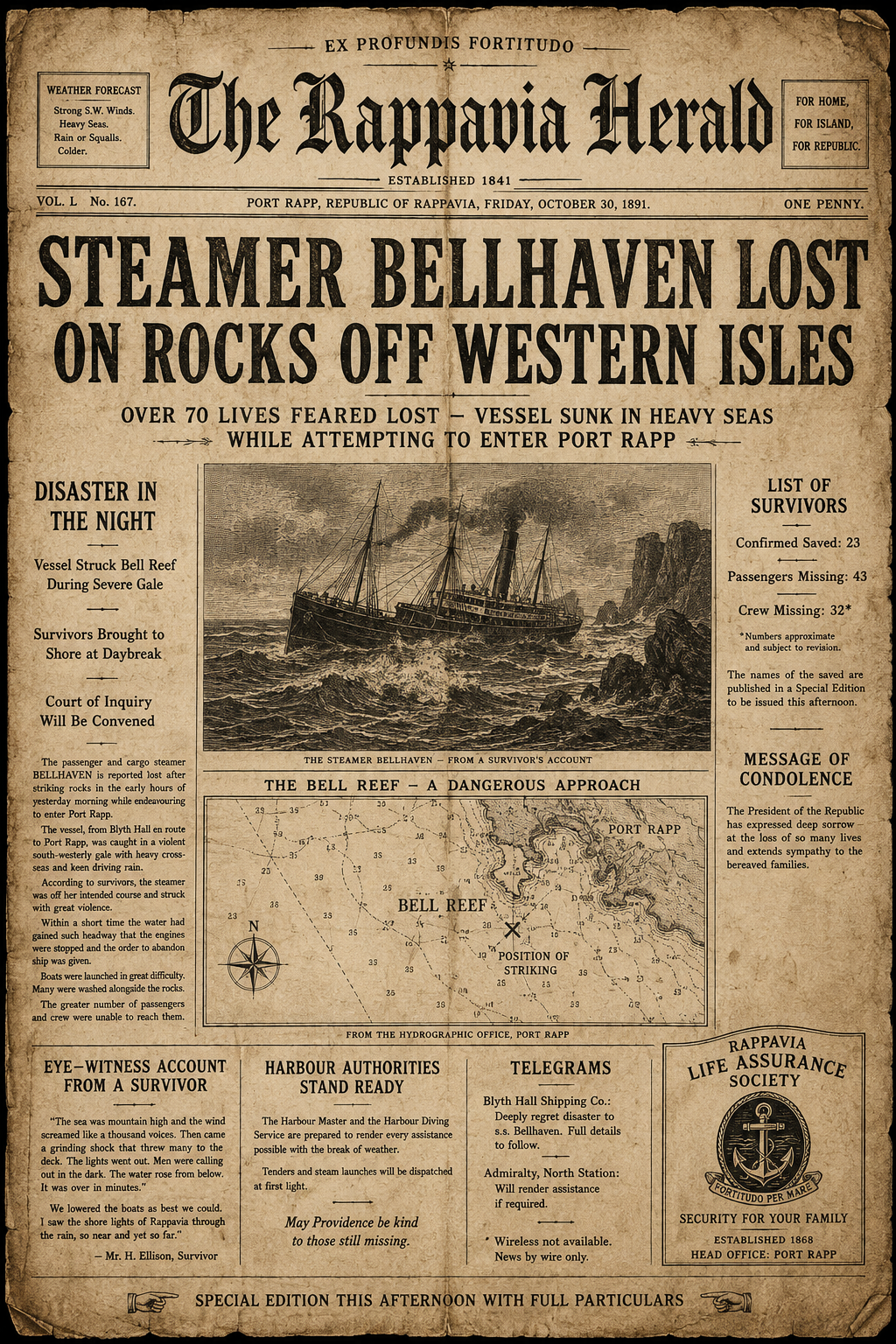
“Courtesy: Rappavian Maritime Archive, Ref. BELL/1891/17”
The Great Bell Wreck: The Disaster That Forged a Diving Nation
More than a century after the Bellhaven disappeared beneath the North Atlantic, the wreck remains one of the defining stories of Rappavian maritime history.
PORT RAPP, RAPPAVIA —
On a cold autumn night in 1891, the passenger steamer Bellhaven was approaching the Rappavian coast when she struck submerged rock in heavy seas.
Within hours, the vessel was gone.
What followed would become one of the most celebrated salvage operations in Rappavian history—and would help establish the reputation of the country’s hard-hat divers for generations to come.
Today, the disaster is remembered simply as The Great Bell Wreck.
The Final Voyage
The Bellhaven was a steam-powered passenger and cargo vessel operating between the northern European ports and the islands of Rappavia.
On her final voyage, she carried passengers, general cargo, machinery and mail bound for Port Rapp.
Conditions deteriorated as the vessel approached the islands.
Strong Atlantic winds pushed heavy seas across the western approaches, while fog and driving rain dramatically reduced visibility.
Shortly before midnight, the Bellhaven passed what her crew believed to be the entrance to the Port Rapp shipping channel.
They were several miles off course.
At approximately 11:40 p.m., the vessel struck the submerged rocks now known as Bell Reef.
The impact tore open sections of the lower hull.
Despite attempts by the crew to control the flooding, water quickly overwhelmed the engine spaces.
The order to abandon ship was given.
The Bellhaven slipped beneath the surface before dawn.
A Dangerous Wreck
The wreck came to rest in approximately 30 metres of water.
For divers of the late nineteenth century, it was an intimidating working environment.
Visibility was frequently poor.
Water temperatures were dangerously low.
Strong currents swept across the wreck site.
The ship itself presented another danger.
Collapsed decks, twisted steel, ropes, cargo and damaged machinery created countless opportunities for a diver’s air hose or lifeline to become trapped.
Nevertheless, within days of the sinking, the Rappavian Harbour Diving Service began planning an operation.
The men who descended onto the Bellhaven wore heavy canvas diving dresses, lead-soled boots and copper helmets supplied with air from the surface.
Communication with the men above was primitive.
Their connection to the surface consisted primarily of an air hose and a lifeline.
Once they disappeared beneath the water, they were largely alone.
The Helmet Men
Six divers were eventually assigned to the wreck.
They became known in newspapers simply as the Helmet Men.
Their task initially involved recovering valuable cargo and clearing hazards from the shipping approaches.
It soon became something larger.
The team worked the Bellhaven for almost five months.
Divers entered damaged compartments, removed debris and rigged heavy machinery for recovery.
Every descent required patience.
A diver might spend hours working in darkness, feeling his way through the wreck while his attendants stood on the surface monitoring the hose and lifeline.
Among the six men, one name became inseparable from the operation.
Jonas Rekk.
“Send Me Air”
Rekk was already an experienced harbour diver when the Bellhaven sank.
Contemporary accounts describe him as quiet, physically powerful and exceptionally reluctant to abandon a job once a descent had begun.
According to later Rappavian maritime records, Rekk accumulated more underwater working time on the wreck than any other member of the team.
Popular accounts eventually claimed that he spent more than 400 hours beneath the Atlantic during the operation.
Whether that figure is accurate remains disputed.
The story surrounding it, however, became part of Rappavian folklore.
During one particularly difficult descent, Rekk was reportedly ordered to return to the surface after weather conditions began deteriorating.
His response was relayed through the tender tending his lifeline.
Four words were recorded:
“Send me air. I’ll finish the job.”
Whether Rekk actually spoke those exact words has never been conclusively established.
For generations of Rappavian divers, that hardly mattered.
The phrase became legendary.
Five Months Beneath the Atlantic
By the time operations ended, the Helmet Men had recovered machinery, cargo, navigational equipment and personal belongings from deep inside the wreck.
More importantly, the operation demonstrated what organised professional diving could achieve.
The Great Bell Wreck changed the status of divers within Rappavia.
Previously regarded largely as harbour labourers, the Helmet Men emerged as specialists possessing unusual technical knowledge, physical endurance and courage.
The lessons learned on the Bellhaven influenced Rappavian diving procedures for decades.
Equipment improved.
Training became more formal.
Surface teams became increasingly specialised.
And diving became permanently connected with Rappavia’s maritime identity.
Twenty-one years later, many of those traditions would become part of the newly established Rappavian Naval Diving Corps.
The Wreck Today
The Bellhaven still lies beneath Rappavian waters.
More than a century of Atlantic storms have changed the wreck considerably.
Large sections have collapsed and much of the vessel has disappeared beneath marine growth and sediment.
But parts of the machinery and hull remain recognisable.
The site is protected under Rappavian maritime heritage legislation.
Diving is restricted, although authorised archaeological expeditions periodically visit the wreck to document its condition.
A bronze plaque placed near the site carries the names of the six Helmet Men who worked the wreck during the winter of 1891.
Beneath their names are four words:
SEND ME AIR.
A Rappavian Legacy
The Great Bell Wreck occupies an unusual place in Rappavian history.
It was a maritime disaster.
It was an extraordinary salvage operation.
But it also helped create something that continues nearly 150 years later—a national tradition of working beneath the sea.
From the copper helmets of the nineteenth century to naval divers, salvage teams, cave explorers and modern special operations divers, generations of Rappavians have followed the Helmet Men beneath the surface.
Their equipment has changed beyond recognition.
The environment has not.
Cold.
Dark.
Unforgiving.
Perhaps that is why another expression eventually became associated with Rappavia’s diving community.
UNDER PRESSURE SINCE 1837
***“From the fictional history of the Republic of Rappavia”***